


Half of Americans Have “Kitchen Envy.” Here’s the $85 Kitchen Upgrade Hiding on Your Oven Handle.
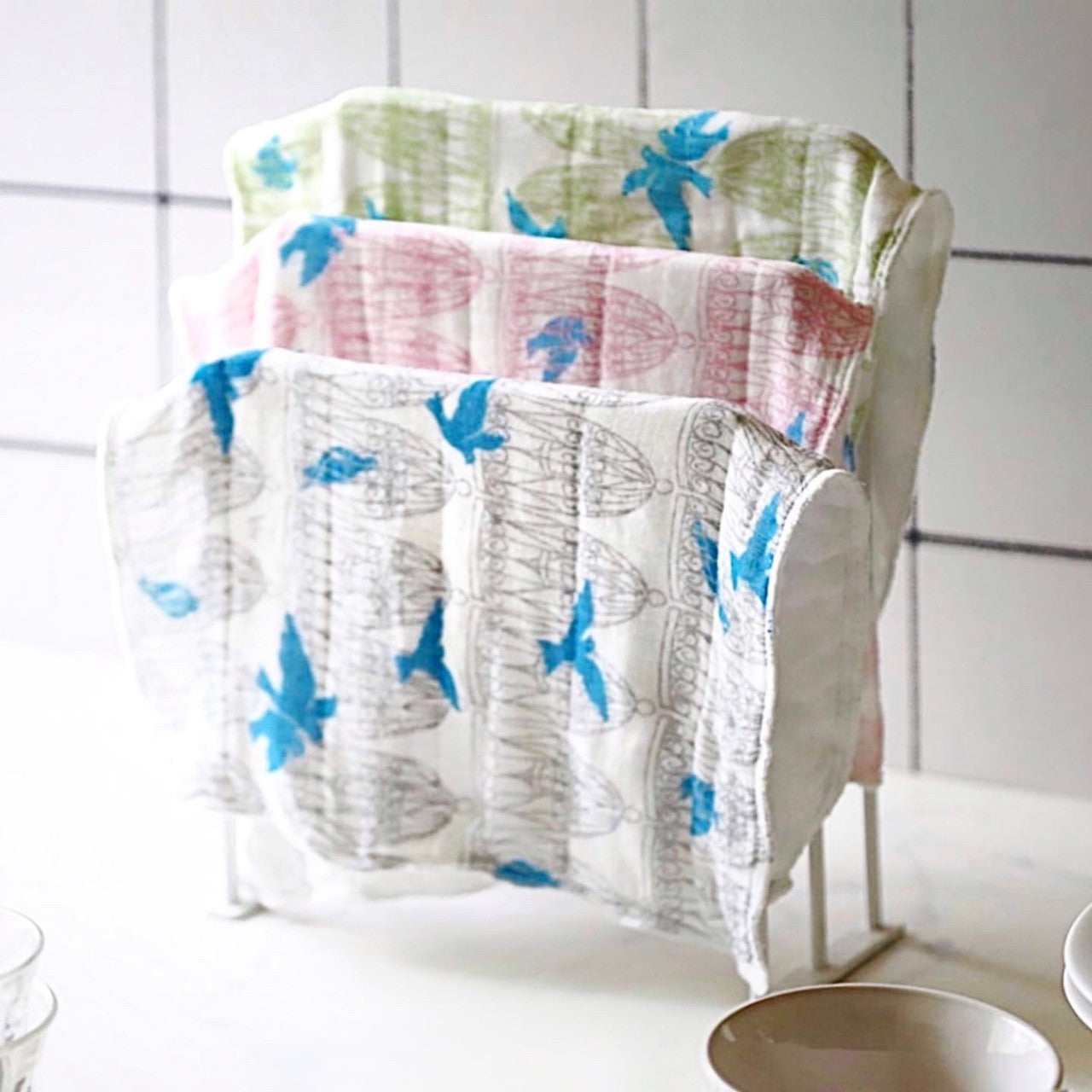
The most-seen square foot of fabric in any kitchen.
In 2024, the luxury appliance brand Thermador paid for a survey of 2,000 Americans. You can guess why. The finding that made headlines: about half of us admitted to "kitchen envy", ( that quiet sting when someone else's kitchen is nicer than ours).
You know the feeling. You've felt it scrolling past a stranger's marble island on Instagram. You've felt it standing in a friend's new renovation, saying "oh, it's gorgeous" and meaning it, while a smaller voice did the math on what it must have cost.
And the survey says the cure is exactly what you'd expect a luxury appliance company to say it is. Layouts. High-end appliances. A dream refrigerator topped the wish list.
In other words: five figures and a contractor.
But before you write off your kitchen until some imaginary renovation year, let me show you something the appliance people have no reason to tell you.
The towel test
Try this. Stand in your kitchen doorway and look at the room the way a guest does — first time, fresh eyes.
The counters are probably fine. The cabinets are probably fine. Your eye slides past all of it, because your eye doesn't price-check. It just notices what's in view.
And then it lands on the oven handle.
There it is. The towel. Maybe a freebie from a set. Maybe one you actually picked, years ago, back when it had a color. Either way it's been hanging there so long you stopped seeing it.
Your guests see it. They'd never say so. But in a kitchen you keep clean and care about, the most visible piece of fabric in the room is the one thing nobody's choosing anymore.
In Japan, the kitchen cloth was never an afterthought
Shirayuki kitchen cloths are woven in Nara, Japan, and printed using the Kyo-Yuzen dyeing technique — the same tradition developed for Kyoto kimonos. Hold one up and you understand immediately: this was designed by someone who expected it to be looked at.
Vibrant fruits. Bluebirds in flight. Crisp geometrics. Cherry blossoms, flowers, motifs that read as deliberate from across the room.

Patterns chosen the way you'd choose anything else on display.
Now picture your own kitchen tomorrow morning. Same counters. Same cabinets. But on the oven handle hangs sage-and-persimmon clovers you picked on purpose. It's a small thing. It is also, your guests would tell you if guests said such things, the difference between a kitchen and a kitchen someone pays attention to.
"The patterns are absolutely adorable, and the quality is outstanding… If it weren't for the shipping cost, I would buy one every time a new cute pattern comes out."
"But a towel that pretty can't actually work… right?"
Fair question. Because you already know the catch with decorating around a towel: most towels disqualify themselves. They stay damp. They go sour by midweek. They end up shoved in a drawer, and you can't style something you're embarrassed by.
This is where Shirayuki stops being decor and starts being Japanese engineering. Each cloth is built on an 8-layer kaya weave — a centuries-old structure originally woven for mosquito netting: breathable, light, strong. It absorbs fast, then releases moisture into the air instead of trapping it. The cloth dries quickly right there on the hook.
Which means it stays fresh enough to live in view. Display-worthy isn't just the print. It's that the cloth earns its place out in the open, day after day.
Now, here's how to do this the smart way
Every Shirayuki order ships from Japan — the same cloths sold there, sent straight to your door, not pulled from some domestic warehouse. The honest catch: international EMS postage is the expensive part, and it costs nearly the same to ship ten cloths as it does to ship two. Ordering one or two is genuinely the worst way to buy them, and we'd rather tell you that plainly than let you find out at checkout.
Here's how we've solved it: at $85, we absorb the entire EMS cost ourselves. You pay for cloth, we pay Japan Post. Which is why experienced customers all buy the same way:
Build the full rotation in one order. Eight to ten cloths. Enough to assign them by job — dishes, counters, hands — enough to swap patterns with the seasons, and enough that there is always, always a fresh one on the hook. At $85, shipping is free worldwide, so every dollar goes to cloth instead of postage.
And if your order reaches $100, we add a free gift to the box. Most people get there by adding one or two patterns they almost didn't pick.
One more thing worth knowing before you browse: patterns sell out, and restocks take a while. Some runs are seasonal. Some are limited editions that never come back. These are woven and dyed in Japan in small batches, not stockpiled in a warehouse — so "I'll add that one to my next order" is how collectors end up hunting a pattern for months. If one catches your eye today, today is the day to get it.

The drawer stops being a graveyard and starts being a collection.
"The cloths are like faithful friends around the kitchen and elsewhere. They're both cute and practical! I bought so many of the designs so I'll always have them handy."
One dinner out. One transformed kitchen.
A full rotation (enough to style the kitchen, swap with the seasons, and never reach for a damp one), costs about what dinner for two does. Dinner is gone by morning. These greet you every day for years. And the pattern you love most is in stock right now, which is never guaranteed next month.
Survey source: Talker Research for Thermador, 2,000 US adults, September 2024.